
Every morning, Sarah opens her inbox to find 147 unread emails. Vendor pitches, newsletter subscriptions she doesn’t remember signing up for, meeting requests, actual work correspondence, automated notifications from a dozen different platforms, and somewhere in that chaos — hopefully — the important message from a potential client that could make or break her quarter.
She spends the first ninety minutes of her workday just sorting through messages, deciding what needs immediate attention, what can wait, and what’s complete noise. By the time she actually starts her real work, she’s already exhausted and her most productive hours are gone.
This scenario plays out in millions of offices worldwide every single day. Email, the tool that was supposed to make business communication more efficient, has become one of the biggest drains on productivity. The average professional receives 121 emails per day and spends 28% of their workweek managing email. That’s more than eleven hours per week just dealing with messages.
But artificial intelligence and machine learning are fundamentally changing this equation. Smart systems are now capable of understanding context, prioritizing intelligently, automating responses, and even predicting what you need before you know you need it. The future of business communication isn’t about receiving fewer emails — it’s about dealing with them infinitely more intelligently.
The Email Overload Crisis
Before we explore solutions, let’s understand the depth of the problem. Email overload isn’t just annoying — it’s expensive. Companies lose an estimated $1.8 trillion annually to productivity losses from inefficient email management. But the costs go beyond just time.
When professionals spend hours sorting through email, they’re constantly context-switching. Each time you shift from writing a report to checking email to returning to the report, your brain needs time to reorient. Research shows it takes an average of 23 minutes to fully regain focus after an interruption. If you’re checking email every fifteen minutes, you never actually achieve deep focus at all.
The psychological toll matters too. Email anxiety is real. That constant awareness of an overflowing inbox creates background stress that impacts decision quality, creativity, and even physical health. Professionals report feeling overwhelmed, constantly behind, and unable to separate work from personal time because email follows them everywhere.
The fundamental problem is that email was designed for a different era. When Ray Tomlinson sent the first email in 1971, no one imagined a world where individual professionals would receive hundreds of messages daily from automated systems, marketing platforms, and global teams spanning multiple time zones. Email wasn’t built for the volume and complexity of modern business communication.
How Traditional Email Management Falls Short
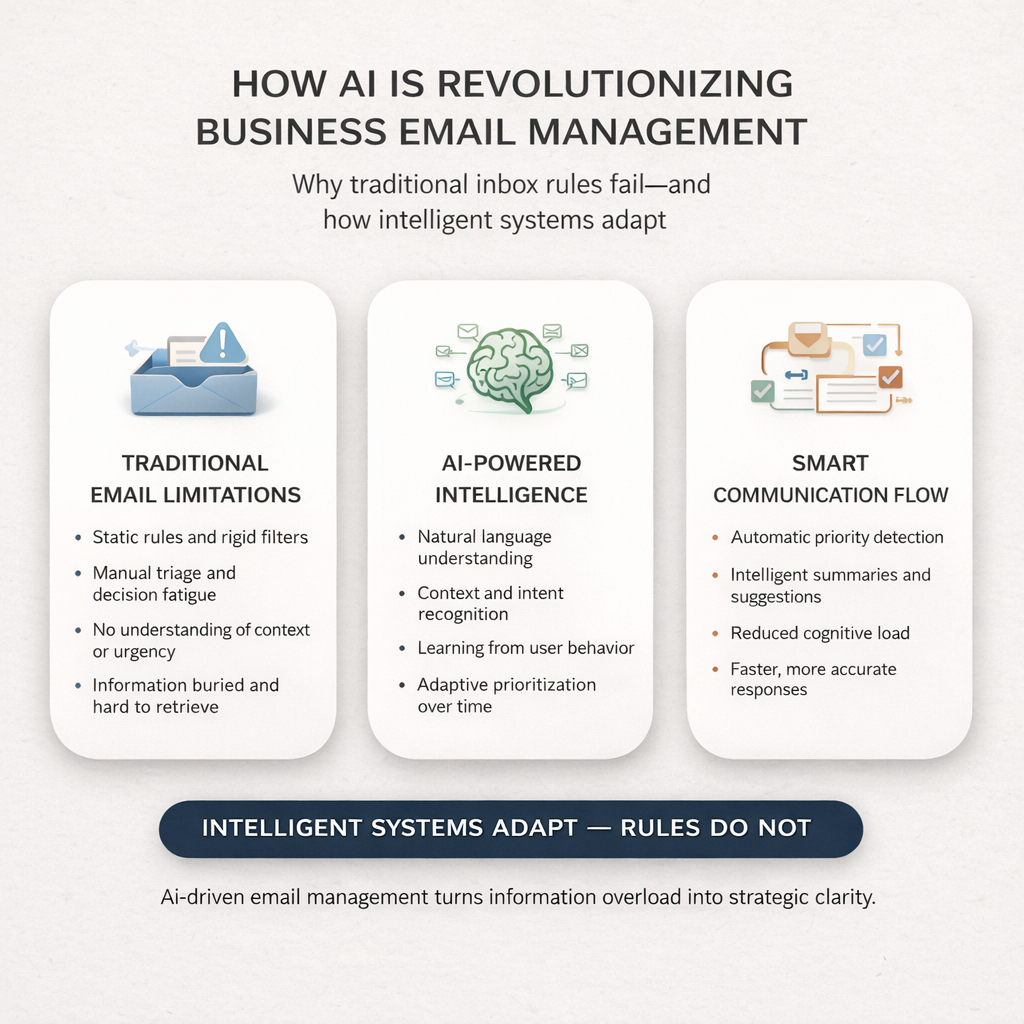
Most professionals rely on a combination of folders, filters, and sheer willpower to manage email. These approaches help, but they’re fundamentally limited because they’re rule-based and static. A filter that moves messages from a specific sender to a folder works only as long as that rule remains relevant. It can’t adapt when priorities shift, understand context, or recognize that today’s “routine” message is actually urgent because of something that happened yesterday.
Manual triage requires constant decision-making. Each email demands a micro-decision: “Is this important? Does this need a response? Should I respond now or later? Where should I file this?” These decisions seem trivial individually, but making hundreds of them daily depletes cognitive resources. By afternoon, decision fatigue sets in, and you’re either overresponding to trivial matters or missing important signals because your judgment is compromised.
Traditional approaches also create information silos. The brilliant insight buried in an email from three months ago might be exactly what you need for today’s problem, but you’ll never find it because you can’t remember the exact search terms or even who sent it. Human memory isn’t designed to index thousands of messages, but we’re forced to rely on it anyway because search tools are primitive.
Enter Intelligent Email Systems Powered by AI
Artificial intelligence and machine learning fundamentally change what’s possible with email management. Instead of following rigid rules, AI systems learn from patterns. Instead of treating every message the same, machine learning algorithms understand context, urgency, relationships, and even sentiment. Instead of requiring constant manual input, intelligent systems adapt automatically as your needs evolve.
Modern AI email management works on several interconnected levels. Natural language processing analyzes message content to understand not just keywords but actual meaning and intent. Machine learning algorithms observe your behavior — which emails you respond to quickly, which you archive without reading, which you spend time on — and use those patterns to predict what matters to you. Predictive analytics anticipate needs based on your calendar, previous correspondence, and even external signals like news about companies you work with.
The result is email management that feels less like drowning in information and more like having an exceptionally competent assistant who knows exactly what you care about and what can safely wait.
Smart Prioritization: Surfacing What Actually Matters
The first major transformation AI brings is intelligent prioritization. Instead of presenting messages in chronological order — treating an automated shipping notification the same as a time-sensitive question from your biggest client — AI systems understand relative importance.
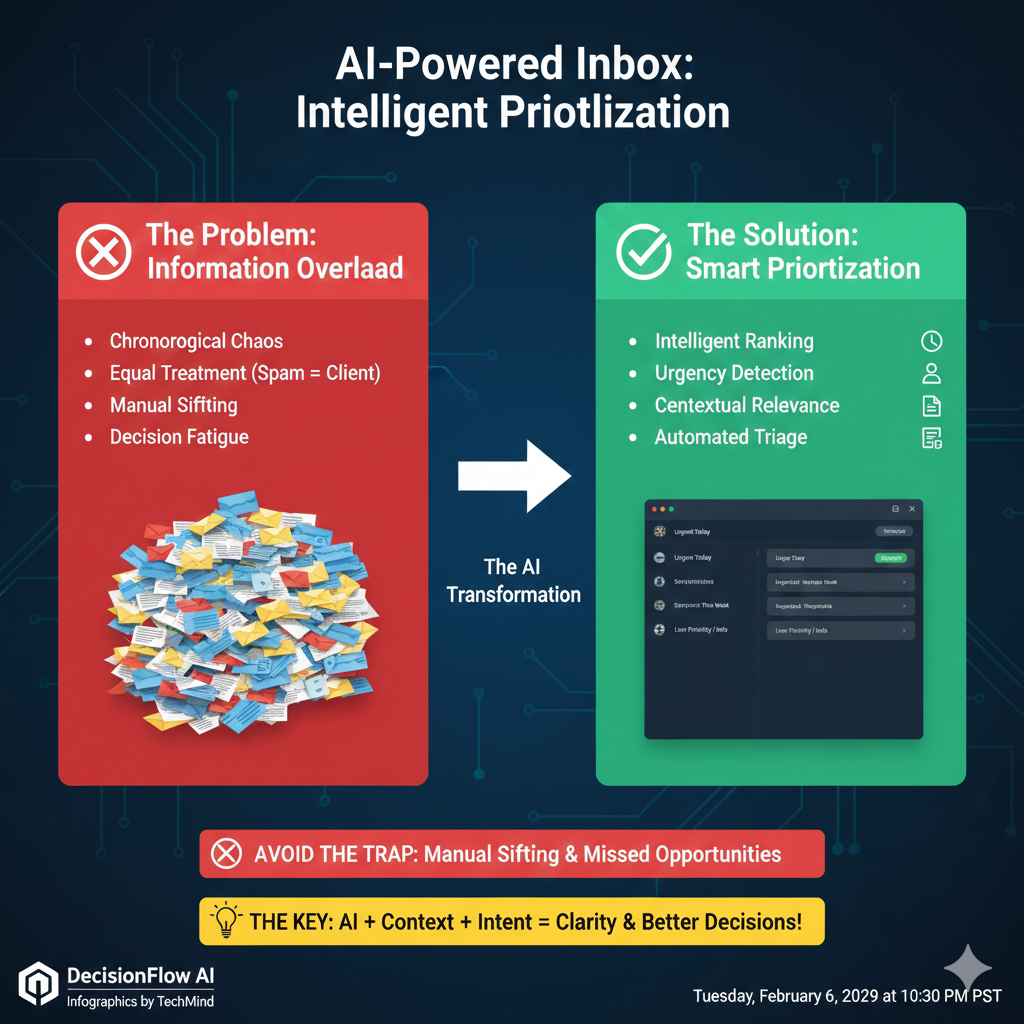
These systems analyze multiple signals simultaneously. Sender importance based on your historical interaction patterns and organizational hierarchy. Message urgency inferred from language patterns and explicit deadline mentions. Topic relevance compared against your current projects and responsibilities. Thread context considering the full conversation history rather than just the latest message. Time sensitivity recognizing that a meeting request for this afternoon is more urgent than one for next month even if the latter came from a more senior person.
The practical impact is dramatic. Instead of scanning through 147 messages, you open your inbox to find the twelve that actually require your attention today, ranked by genuine urgency. The other 135 are sorted intelligently — some automatically archived because they’re purely informational and you’ve never responded to similar messages, some scheduled to resurface later when they become relevant, others filed into context-appropriate categories you can review when time permits.
This isn’t just convenient. It’s transformative for decision quality. When you’re not overwhelmed by volume, you can give appropriate attention to messages that deserve it. You respond more thoughtfully because you’re not rushing to get through a mountain of unread mail. You make better decisions because you’re not suffering from decision fatigue.
Automated Response Suggestions and Workflow Acceleration
Another powerful AI application is intelligent response generation. Modern systems can analyze incoming messages and suggest appropriate replies based on context, your previous responses to similar inquiries, and even your writing style.
For routine communications — confirming meeting attendance, acknowledging receipt of information, providing standard information that you’ve shared dozens of times — AI can draft complete responses that often need minimal editing or none at all. This doesn’t mean robotic, identical replies. Machine learning systems learn your communication patterns and generate responses that sound like you.
For more complex communications, AI systems provide useful scaffolding. They might suggest key points to address based on the incoming question, pull relevant information from previous correspondence, or even draft an outline you can flesh out with specifics. The system handles the mechanical aspects of communication while you focus on the strategic and relationship elements that genuinely require human judgment.
The time savings compound quickly. If you can handle thirty routine messages in ten minutes instead of an hour because AI is drafting responses, that’s fifty minutes redirected to higher-value work. Multiply across an organization of hundreds or thousands of employees, and the productivity gains become staggering.
Intelligent Email Security and Privacy Management
AI also enhances email security in ways traditional rule-based systems cannot. Machine learning algorithms detect anomalous patterns that might indicate phishing attempts, account compromise, or social engineering attacks. These systems recognize that a message from your CEO asking you to urgently purchase gift cards and send the codes is suspicious even if it comes from the correct email address, because the request pattern doesn’t match typical communications from that person.
Beyond security threats, AI helps manage the more mundane but equally important challenge of email privacy and inbox hygiene. When you’re researching vendors, subscribing to industry newsletters, or registering for webinars, you’re sharing your email address widely. Each of these interactions creates potential for future inbox clutter.
Smart professionals are increasingly using throw away email services for non-critical registrations and vendor research. These disposable addresses let you receive necessary information without committing your primary inbox to ongoing communication. But managing which emails go to which addresses, and keeping track of multiple temporary addresses, creates its own complexity.
This is where AI-powered email management systems excel. They can intelligently route messages based on sophisticated rules, automatically clean up temporary addresses when they’re no longer needed, and even learn which types of communications you prefer to receive at which addresses. The system becomes a smart intermediary that protects your primary communication channels while ensuring you still receive information you actually want.
Predictive Email: Anticipating Needs Before They Arise
Perhaps the most futuristic aspect of AI email management is predictive capability. Advanced systems don’t just react to incoming messages — they anticipate needs and surface relevant information proactively.
Imagine you have a meeting scheduled with a client this afternoon. An AI email system can automatically compile a dossier: recent email threads with this client, action items from the last meeting, relevant files you’ve exchanged, and even news about their company that might be worth mentioning. You don’t have to search for any of this. It’s assembled automatically and surfaces when you need it.
Or consider project management. As a deadline approaches, the system might notice you haven’t received expected deliverables from a team member and proactively alert you to follow up. It recognizes patterns like “three days before deadline, you typically receive draft materials” and flags anomalies that might indicate problems.
These predictive capabilities transform email from a reactive communication channel into a proactive intelligence system. You’re not just managing messages as they arrive. You’re working with a system that understands your workflows, anticipates obstacles, and surfaces information before you even know you need it.
Integration with Broader Business Intelligence
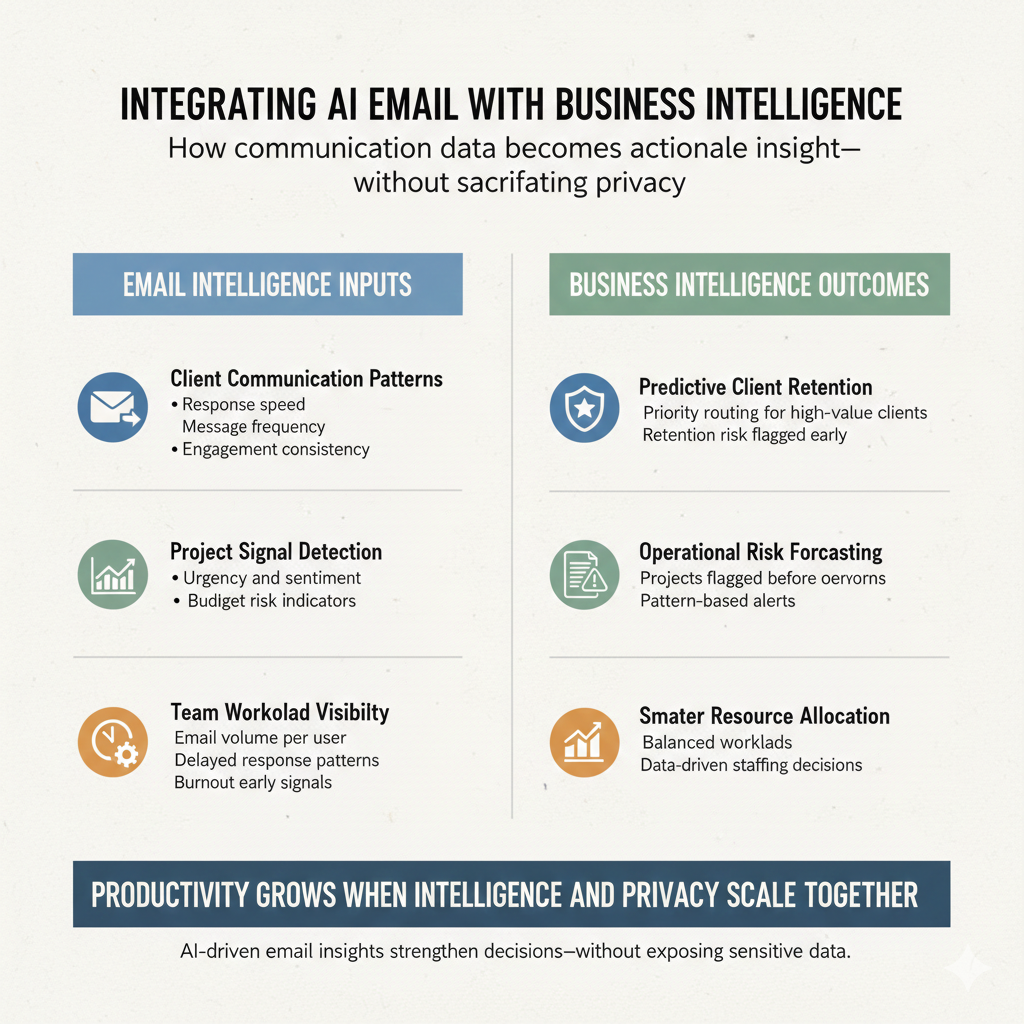
The real power emerges when email AI integrates with broader business intelligence systems. Companies specializing in transforming data into intelligent decisions — like sophisticated platforms that analyze business metrics, customer behavior, and operational efficiency — increasingly incorporate email data into their models.
Your email communication patterns reveal valuable business intelligence. Which clients are most engaged based on response times and email frequency. Which projects are at risk based on the sentiment and urgency of messages. Which vendors are reliable based on their communication consistency. Which team members might be overloaded based on their email volume and response patterns.
This integration creates feedback loops that make everything smarter. The business intelligence platform identifies that response time to certain client segments correlates with retention, so the email AI automatically elevates messages from those segments. The email system notices that projects with certain communication patterns tend to go over budget, so it flags similar patterns earlier in future projects. Everything learns from everything else.
Practical Implementation: Starting Your AI Email Journey
If you’re convinced that AI can transform email management, the question becomes how to actually implement these capabilities. The good news is that you don’t need to overhaul your entire communication infrastructure overnight.
Start with low-hanging fruit. Most modern email platforms already offer basic AI features like smart categorization and simple priority sorting. Enable these features and use them consistently so the system learns your patterns. Pay attention to what it gets right and what it misses. The algorithms improve with feedback, so actively train the system by marking important messages and moving misclassified ones to the correct categories.
Gradually expand to more sophisticated tools. Email plugins and extensions can add advanced AI capabilities to existing email clients. These tools often specialize in specific functions — intelligent scheduling, response generation, and reminder management — and can be adopted incrementally based on your biggest pain points.
For organizations, consider dedicated AI email management platforms that offer enterprise-grade features. These systems provide centralized management, advanced analytics, and integration capabilities that consumer tools lack. The investment pays for itself quickly through productivity gains, especially for teams where email management consumes significant time.
The Privacy-Productivity Balance
As email AI becomes more sophisticated, legitimate questions arise about privacy and data usage. Systems that learn from your communication patterns necessarily analyze your messages. How do you balance the productivity benefits of AI with privacy concerns?
Reputable AI email systems address these concerns through several approaches. Processing can happen locally on your device or within your organization’s infrastructure rather than sending all data to external servers. Encryption ensures that even if data is processed externally, it remains protected. Clear policies specify exactly how your data is used and guarantee it’s never sold or shared without explicit consent.
When evaluating AI email tools, prioritize vendors who are transparent about data handling, offer clear opt-out mechanisms, and provide granular controls over what the AI can access. The right balance gives you intelligence benefits while maintaining appropriate boundaries around sensitive information.
For particularly sensitive communications, maintain traditional workflows. AI email management doesn’t have to be all-or-nothing. You can designate certain accounts, folders, or senders as off-limits to AI analysis while gaining efficiency benefits everywhere else.
The Future: Ambient Intelligence in Communication
Looking ahead, email AI will likely become even more ambient and invisible. Future systems won’t require you to actively manage or train them. They’ll understand context from your calendar, your files, your organization’s knowledge base, and even your communication style in other channels like chat and documents.
These systems might proactively draft communications before you even think to send them. “Based on your calendar and previous patterns, you typically send a project status update to your team on Friday afternoon. Here’s a draft based on this week’s developments.” You review, adjust if needed, and send — or let the AI send automatically if you’ve indicated that type of update can be handled autonomously.
Email might evolve beyond its current form entirely. As AI becomes better at understanding intent and context, we might move toward more natural, conversation-like interfaces where you simply express what you want to accomplish and the system handles the underlying communication mechanics. “Make sure the design team knows the client wants to see mockups by Tuesday” becomes a simple voice command, and the AI handles crafting appropriate messages to the right people with the right context.
Conclusion: Intelligent Communication for Intelligent Business
Email overload isn’t inevitable. It’s a byproduct of trying to manage 21st-century communication volume with 20th-century tools and approaches. Artificial intelligence and machine learning provide the capabilities needed to transform email from a productivity drain into a genuine asset.
Smart prioritization ensures you focus on what matters. Automated workflows handle routine communications efficiently. Predictive systems surface information before you need it. Integration with broader business intelligence creates powerful feedback loops that make your entire operation smarter.
The transformation has already begun. The professionals and organizations that embrace AI email management now will have significant competitive advantages over those still drowning in inbox chaos. They’ll make better decisions because they’re not overwhelmed. They’ll respond faster because relevant messages surface immediately. They’ll build stronger relationships because they give appropriate attention to communications that deserve it.
Start small but start today. Enable AI features in your current email platform. Experiment with intelligent tools that address your biggest pain points. Use smart approaches like temporary email addresses for non-critical communications. Pay attention to which aspects of email management consume disproportionate time and seek AI solutions that address those specific problems.
The future of business communication isn’t about receiving fewer emails. It’s about using artificial intelligence to transform data — including all those messages — into intelligent decisions about where to focus your limited time and attention. That future is already here. The question is whether you’ll take advantage of it.